
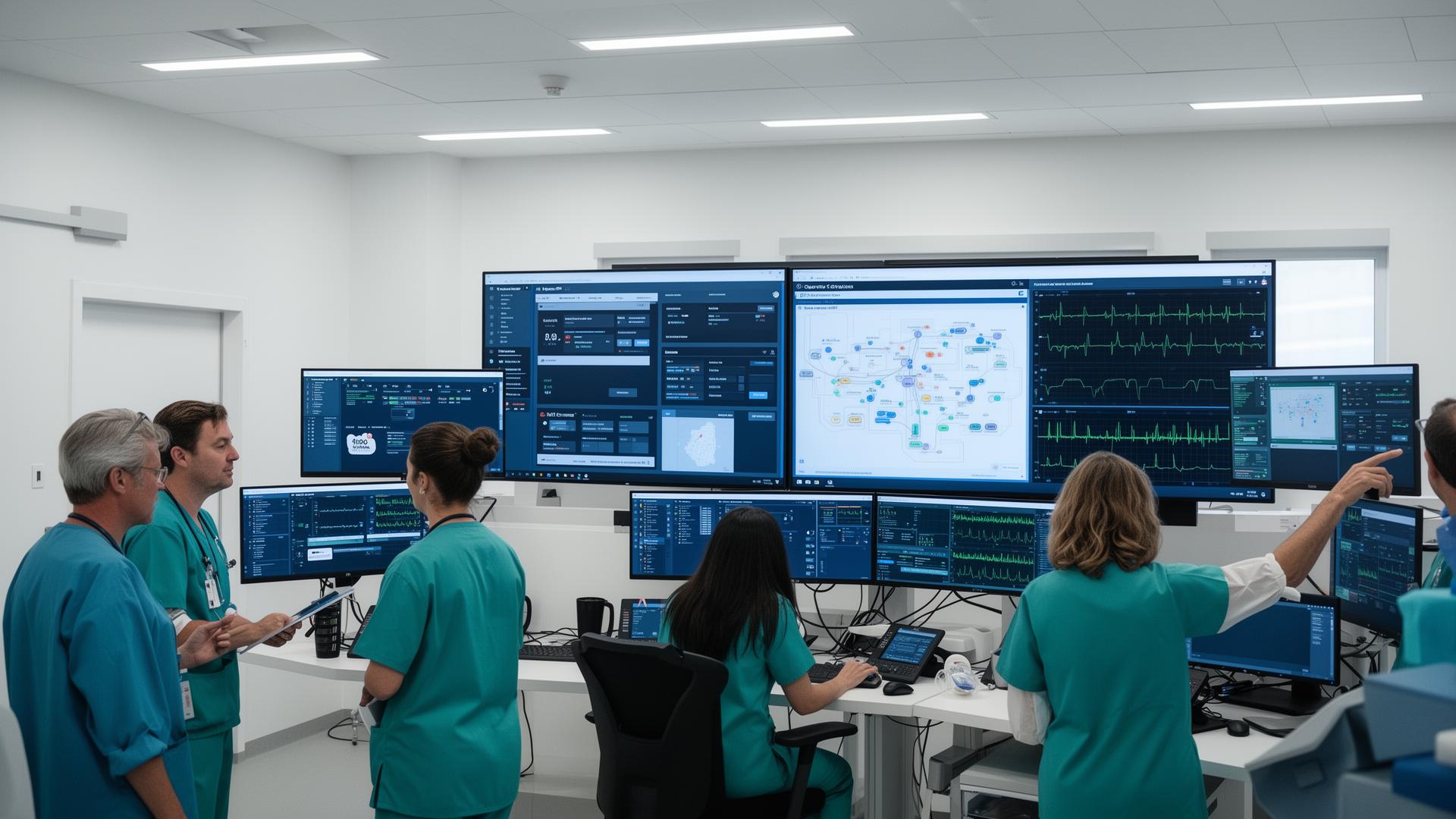
Health Platform
A coordinated data fabric for health systems, ministries, and clinical research.
How this platform works in everyday language.
Hospitals, regional health clinics, national drug warehouses, and disease control centers often run on completely separate computer systems. When an illness spreads or medicines run low, leaders only learn about it weeks later through phone calls and manual paper reports. Cerebro Dynamics Health connects clinics, labs, and pharmacies into one live network. Health officials can track disease outbreaks as they happen, watch cold-storage vaccine temperatures in real time, and make sure remote clinics never run out of vital medications.
What this platform addresses.
Patient records, public health surveillance, supply chains, and clinical research run on parallel systems that rarely speak to each other. Cerebro Dynamics Health connects them under a single, privacy-first record fabric.
Who uses this platform in daily work.
Monitors unexpected symptom spikes across clinics to detect cholera, malaria, or respiratory outbreaks within twenty-four hours.
Tracks bed occupancy, patient transfer bottlenecks, and surgical inventory across six regional hospitals.
Oversees solar-powered vaccine refrigerators in rural health posts using live temperature sensors.
Gathers anonymous patient records across multiple teaching hospitals to evaluate maternal health treatments.
How the system is built.
Interoperable record fabric with standardized clinical ontology, surveillance pipelines, supply visibility, and operational dashboards — all sharing the same identity and consent layer.

What ships in the platform.
FHIR-native longitudinal patient record.
Outbreak detection and field response coordination.
End-to-end visibility across vaccine and pharma logistics.
Governed cohort building for research and trials.
What it does.
- 01Patient record interoperability (FHIR-native)
- 02Disease surveillance and outbreak modelling
- 03Supply chain and cold-chain visibility
- 04Clinical research cohort building
- 05Population health analytics
- 06Pharmacovigilance and adverse-event signal detection
Real-world operational examples.
Halting a Regional Cholera Outbreak
During heavy seasonal rains, several rural clinics reported rising waterborne disease cases, but paper forms took two weeks to reach the national ministry.
Clinics logged basic patient counts through our offline-capable mobile interface. The platform mapped the cases to specific community water boreholes within eighteen hours. Response teams dispatched chlorine tablets and medical personnel immediately, stopping transmission before it reached urban centers.
Eliminating Vaccine Spoilage Along Rural Distribution Routes
A provincial health department regularly lost twenty percent of its childhood vaccines due to unexpected generator failures in rural clinics.
By connecting Internet of Things temperature monitors directly to the Health Platform, depot managers received automated alerts whenever refrigerator temperatures climbed above eight degrees Celsius. Technicians repaired backup generators before vaccines spoiled, preserving critical supplies.
A typical operating loop.
A surveillance officer detects a regional anomaly, triages cases through the record fabric, dispatches resources through the same operational layer, and reports back to the ministry from one continuous workspace.
Data model.
FHIR-compatible, with controlled connectors to laboratory, imaging, genomic and supply systems.
Posture.
Patient privacy by default, policy-based access, full audit, and de-identification pipelines for research and surveillance reuse.
DeploymentNational sovereign cloud or hybrid public-private arrangement.
What operators ask before deployment.
Where it is deployed.
- Healthcare
- Government
- Research and Biotechnology